Showing posts with label Earth. Show all posts

Sunday, August 14, 2011

Darkest Planet Found is Blacker Than Coal, Reflects Almost no Sunlight

Astronomers discovered a planet they say is the darkest known exoplanet as it reflects almost no sunlight and is blacker than coal.


The planet, which they named TrES-2b, is a distant, Jupiter-sized gas giant situated in our home galaxy, and was discovered with NASA's Kepler space telescope. It reflects less than 1 percent of the starlight that falls


on it, scientists say, which is what makes TrES-2b blacker than coal or any planet or moon in our solar system.


"Being less reflective than coal or even the blackest acrylic paint -- this makes it by far the darkest planet ever discovered," lead study author David Kipping told National Geographic. "If we could see it up close it would look like a near-black ball of gas, with a slight glowing red tinge to it, a true exotic amongst exoplanets."


Their research will be published in the Monthly Notices of the Royal Astronomical Society and is available online.


The Kepler spacecraft orbits the Earth and is designed to find planets outside our solar system.


TrES-2b is 750 light-years from Earth and Kepler, which is also designed to precisely measure the brightness of distant stars, detected a subtle dimming and brightening because of the planet's changing phase.


These dips in stellar brightness could be an indication that a planet is transiting, or passing in front of its star, relative to Earth, blocking some of the star's light-in the case of the coal-black planet, blocking surprisingly little of that light, National Geographic stated.


"It's not clear what is responsible for making this planet so extraordinarily dark," said co-author David Spiegel of Princeton University, in a statement. "However, it's not completely pitch black. It's so hot that it emits a faint red glow, much like a burning ember or the coils on an electric stove."

Thursday, July 28, 2011

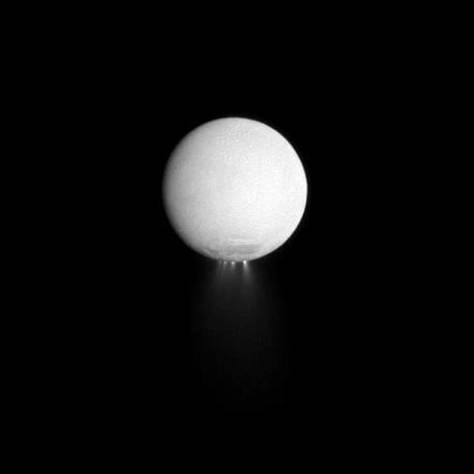
Moon Rains Water on Saturn in Baffling Phenomenon

"There is no analogy to this behaviour on Earth," said Paul Hartogh of Max-Planck-Institut für Sonnensystemforschung, the scientist who led the analysis that yielded the odd results.
Hartogh and other scientists who analyzed information from European Space Agency's (ESA) Herschel space
observatory concluded that one of Saturn moons, called Enceladus, is raining water vapors that form a huge donut-shaped ring around Saturn. 
Furthermore, it's dropping water vapor right in Saturn's atmosphere. So far, it's also the only moon in the solar system to influence the chemical composition of its parent planet. 
Enceladus rains about 250 kg of water vapour per second, according to the ESA. At this volume, the vapors can get through to Saturn despite some being lost in space, falling to other Saturn moons, and freezing on Saturn's rings.
About three to five5 percent of the water expelled from Enceladus end up on Saturn, according to ESA estimates. Ultimately, the water vapor is transported to the lower levels of the planet in small amounts. 
The water vapors come from the moon's south polar region. The exact origin of the water and why it's spewing from Enceladus is unclear. However, one hypothesis is that the vapor originates from an underground of reservoir of saltwater in Enceladus, according an analysis by Frank Postberg of Heidelberg University, reported Scientific American.
"Herschel has proved its worth again. These are observations that only Herschel can make," said Göran Pilbratt, ESA Herschel Project Scientist.
The puzzling existence of water vapors in Saturn's atmosphere was first discovered in 1997 by the ESA.  Now, 14 years later, the ESA is one step closer to solving this mystery.
Popular Multimedia

Thursday, July 21, 2011

Aurora on Exoplanet 'Hot Jupiter' Depicted [VIDEO]

A new model has been created that shows aurorae on distant "hot Jupiters" can be up to 1000 times brighter than Earth aurorae, or Northern and Southern Lights.
Researchers at the Harvard-Smithsonian Center for Astrophysics have depicted a model of what they believe
an aurora on a "hot Jupiter" would look like: a stellar light show spectacle that encapsulates the entire planet in a ripple effect.
Ofer Cohen, who led the research project, and his team used computers to model the events following a solar eruption hitting a gas giant.
The ripple effect would last over a course of about 6 hours, with the aurora 100-1000 times brighter than Earth's moving up and down from the equator toward the north and south poles rather than just restricted to the Polar Regions. In other words, it would be a planet wide show encompassing the entire exoplanetary atmosphere.
"I'd love to get a reservation on a tour to see these aurorae!" Cohen said.
Aurorae are created on Earth when particles from the Sun charged with energy crash into Earth's magnetic field. Air molecules light up like neon signs when the magnetic field steers particles towards the North and South poles creating the Aurora Borealis and Aurora Australis. This same process can happen on all planets, even including exoplanets.
However, co-author of the research Vinay Kashyap said, "The impact to the exoplanet would be completely different than what we see in our solar system, and much more violent."
After the computer simulated model was finished, researchers found that the illumination that an aurorae on an exoplanet, while being smiliar to that of Earth, can possibly engulf the entire globe due to the high speed impact of stellar plasma to an exoplanet that is just a few million miles from its star.
"Hot Jupiters" would feel a strong blast similar to being one mile away from a volcano eruption, though research shows that gas giant exoplanets are quite capable of defending themselves against a stellar explosion, according to Irish Weather Online. The exoplanet's magnetic field shields its atmosphere from erosion due to a protective mechanism within the exoplanet.
The first exoplanet "Hot Jupiter" was discovered in 1995 and is called 51 Pegasi b, or more commonly known as Bellerophon. It was the first extrasolar planet found similar in mass to Jupiter that orbits a Sun-like star.

Thursday, July 7, 2011

Saturn storm pictured

The storm has caused a 'Great White Spot' on the planet which is visible from the Earth.
Observations from the Cassini spacecraft - combined with images from ground-based telescopes - reveal the electric spectacle which is producing a tempest so intense the flashes are occurring at the rate of up to ten times a second, say researchers whose findings are published in two papers in Nature.
Great White Spots are so-called because they are large enough to be visible by telescope from Earth and

break out rarely - about once every thirty years.
This outburst began last December as Cassini orbited the usually calm ringed planet while a network of ground-based observers also monitored the storm's evolution.
Planetary scientist Professor Agustin Sanchez-Lavega, of the School of Engineering of Bilbao, and colleagues said: "
Huge storms known as Great White Spots, which are ten times larger than the regular storms, are rarer and occur about once per Saturnian year (29.5 Earth years)."
It is only the sixth time the once-in-a-generation phenomenon - which occurs as spring comes to the 87,000 mile wide planet's northern hemisphere - has been spotted since 1876.
The storm has a latitude and longitude of 6,200 and 10,500 miles respectively - meaning it would spread across half of the Earth.
Dr Georg Fischer, of the Austrian Academy of Sciences in Graz, and colleagues said in a second study: "The visible plume consists of high-altitude clouds that overshoot the outermost ammonia cloud layer owing to strong vertical convection, as is typical for thunderstorms.
"The flash rates of this storm are about an order of magnitude higher than previous ones, and peak rates larger than ten per second were recorded.
"This main storm developed an elongated eastward tail with additional but weaker storm cells that wrapped around the whole planet by February 2011. Unlike storms on Earth, the total power of this storm is comparable to Saturns total emitted power."
They said the appearance of such storms in the northern hemisphere could be related to the change of seasons.
Physicist Professor Peter Read, of Oxford University, reviewed the papers for the journal and said they present "some of the most detailed observations so far of such a dramatic event."
He said: "These observations reveal with great clarity that the GWS comprises a massive complex of convective thunderstorms, upwelling heat energy and moisture from levels deep within Saturn's atmosphere, accompanied by huge and almost continuous lightning discharges.
"It will be a major challenge to the next generation of atmospheric models to predict when (and where) storm clouds will next appear to brood over Saturn's normally bland and hazy face."